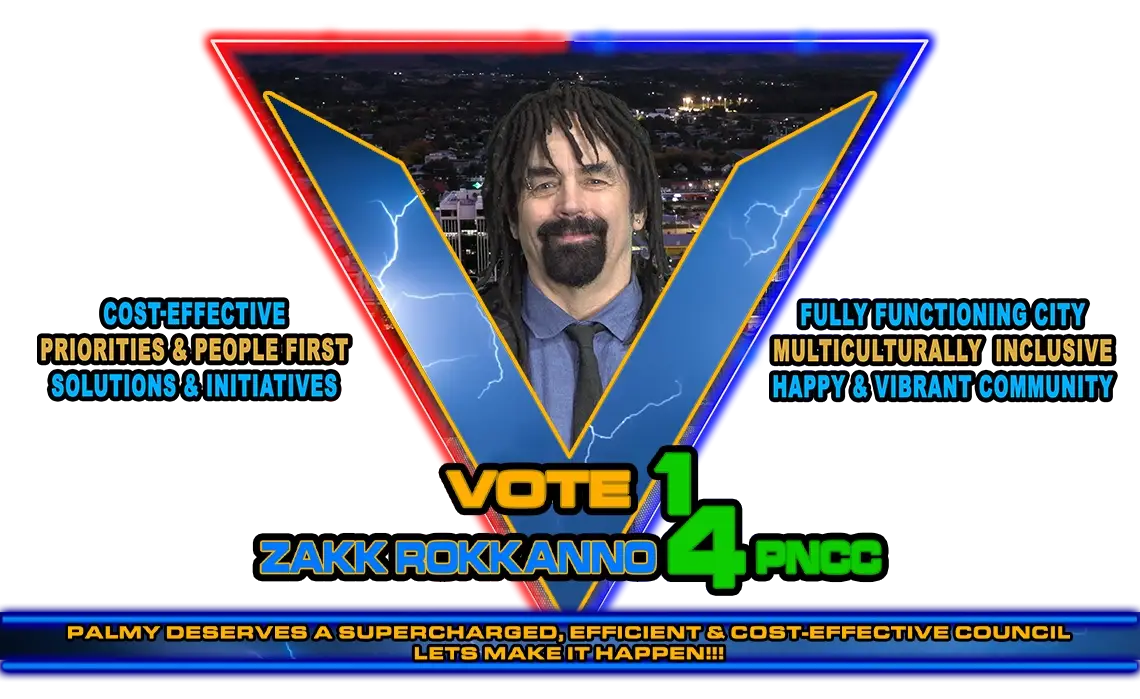
ZAKK4PNCC
ZAKK’S POLICIES
Click each button for a dropdown
The 1st button in each Color-Coded section is a Policies Summary for that section
A more in-depth policy explanation is in each of the other buttons in the section
My policies have been arranged with the Council section first
This is followed by a section for each of the PNCC Long Term Plan goals, which I fully support
Introducing Zakk Rokkanno
Growing Up Around Aotearoa NZ
Kia ora, I’m Zakk Rokkanno,
I’m proud to once again stand as an independent candidate for PNCC.
Growing Up
Palmy Born
I was born in Palmy, at a not-so-little-now Hospital near the corner of Ruahine St & Tremaine Av.
Dairy Farm in Helensville, Lots of Cows & Eels
A couple of weeks later it was of to my Dad’s dairy farm in Helensville for my 1st 12 years of being alive.
I learned milking, catching eels in our farm-side tidal river & developed a love of science & sci-fi.
I had a comic collection that was the envy of many, The Trigan Empire & Superman amongst my favs.
Westie in Massey, Auckland – Started Filming
After that a few years in Massey & getting used to city life.
I learned a few things there, got into filming after getting a vintage super 8 movie camera, & began to wonder why the world at large was so messed up.
Pub Life in Southland
Then the folks bought a place in Palmy, then left Te Ika-a-Māui [North Island] and went off to a pub they bought at the very bottom of Te Waipounamu {South Island]
That was a collection of interesting lifestyles, our bars were like big living rooms where I could always find someone for a game of pool, or darts.
I got a first-hand look at how messed up people can get on the alcohols & learned a lot.
Invercargill A-Go-Go:
Shadbolts & Short-Film Successes
Then, after the folks went back to the Palmy homestead, I stayed on in Southland, in Invercargill, for a few years where I developed my video production skills and even as a stringer for TV3 News for a while.
I worked on Tim Shadbolts Mayoral campaign. which was an interesting introduction to my involvement in local politics.
I had Tim chased around by planes & more in the election vids I made for him & he did get elected as Mayor, & stayed there until 2022.
Filming highlights were being suspended from a helicopter a couple of times while filming boat show entries & also the sinking ‘Dong Won 529’ after it collided with rocks near Rakiura [Stewart Island]
I also won a short film contest, winning 4 awards for nuking the world & drowning Invercargill in a massive tidal wave. Go Figure!
WellyWood Experiences
Amidst all that I spent a bit of time in Absolutely Positively Wellington, & managed a score few small acting which was fun as I love acting.
Back to Palmy
Then it was back to my birth-town of Palmy and have been here ever since
Why am I Standing for PNCC?
Why am I standing for PNCC?
I CAN Make A Positive Difference for Palmy!
Because I want to make a positive difference for our city and its diverse, multicultural community.
I am confident I have the qualities and determination to achieve that – not only by addressing what has gone wrong, but also by driving forward new ideas and initiatives
My goal is to help propel Palmerston North into a rewarding future that benefits all of us.
A FULLY FUNCTIONING City is a MUST!
I believe it is vital that our city runs efficiently and effectively – delivering the essential services that keep Palmerston North functioning every day.
Strong infrastructure, reliable services, and sound financial management are the foundation of everything else.
A Strong Interactive Represented, Interactive & Happy Community
At the same time, I stand firmly for ‘Community First’.
That means ensuring our people, neighbourhoods, and shared spaces are at the heart of every decision.
Community projects should never come at the expense of core city functions — instead, both must work together.
A well‑run city creates the stability that allows community initiatives to thrive, and thriving communities give purpose to the city’s systems
Yes, I have Dreadlocks!
Yes, I have DREADLOCKS!
For me,
My dreadlocks represent the individuality and the pride I take in thinking for myself, rather than blindly following social or political constructs that don’t reflect who I am or how I choose to live.
I’ve been advised – in good faith – that my dreadlocks might put some voters off, particularly older ones.
Should I change Myself to Get More Votes???
But should I change my look just to please voters?
NO!!!
Why not, even if it meant more votes?
Because my appearance is more than style
it reflects my independence and my determination to think & act on my own terms.
And I like the look that I see in the mirror
To change it for political gain would betray the very principle that guides my leadership: making decisions on their merits, standing up for what I believe in, and challenging what I disagree with.
If I compromised on that, I’d undermine the very reason people might choose to vote for me in the first place
Would you want someone in council who was so superficial that they would change themselves away from something they were happy with in order to win approval from others???
To do that would be selling myself out before I even started, as it would make me appear weak and superficial, when what this city needs is substance and determination.
Palmy needs leadership that is Strong & Decisive, NOT easily led!
Nándor Tánczos was a dreadlocked MP & he is remembered as a principled & authentic politician. Not too many can claim that!
To be a strong and worthwhile councillor, I must show that I won’t let the opinions of others dictate my identity.
That same courage – to stand firm in who I am – is the courage I’ll bring to council decisions.
I want people to vote for me not because I fit a mould,
but because of the unique voice I bring,
and the passion and determination I have to drive forward decisions and initiatives that will make Palmerston North stronger, more positive, and better for everyone.
Video Skills / Equality / Independant Stance
I have Video & Media Production Skills
As a Video and Multimedia Producer, I bring creative and technical skills that help me communicate positive, cost‑effective, and efficient solutions for our city and its multicultural communities.
I Care about Palmy & Represent Fair Play & Equality for ALL
I care deeply about Palmerston North and will work to ensure everyone is treated fairly, represented equally, and given the opportunities they deserve.
I am Independant, as I don’t believe in Party Politics
I stand independent of political parties, because I believe every issue should be assessed on its own merit – prioritised by its real need and benefit for our people, not by rigid party policy manifestos that dictate what I have to agree with.
My Approach, If Elected to PNCC
My Approach, if elected to PNCC
Best Outcomes for Lowest Cost to Ratepayers
As a councillor, my focus will always be on achieving the best outcomes while protecting ratepayer value: streamlining budgets, reducing costs where possible, and never compromising quality or long‑term efficiency.
I will ask the questions that need to be asked!
If something doesn’t seem right to me I will ask questions & challenge what I disagree with.
I love the diversity across humanity
as long as ‘Do No Harm’ is practised
I respect and celebrate the diversity of our communities, supporting the right of everyone to live authentically, provided they do no harm to others.
I REJECT toxic stereotypes, & ‘US vs THEM’ attitudes
as divisive approaches destroy human unity
I reject toxic stereotypes, elitism, and “us vs them” attitudes, approaches & politics.
Instead, I choose to focus on positive, inclusive community‑building that works for everyone.
Positive Community Education is Vital
I believe greater community education is essential, empowering people to make informed, sustainable choices in their daily lives & for their futures.
Our peoples need to be taught from a young age how to think for themselves & be independent with a strong inner confidence that will shield them from controlling, gaslighting types by learning they don’t need the approval of others to feel good about themselves, as long as they do no harm.
Life can be hard & tough to deal with, especially in the face of extreme adversity, but if people see life as an obstacle course that helps them develop strong life-skills they will be more inspired to survive their lows.
“What doesn’t kill you makes you Stronger”
A strong sense of inner confidence is the very best shield against depression & suicidal thinking.
Long-Term Plan & Environmental Protection
I fully support PNCC’s Long-Term Plan goals for building a future‑focused, sustainable, resilient & resourced city & a community that is well‑represented, thriving, interactive & happy, while protecting our environment for the years to come.
My Policies are aligned with PNCC’s Long-Term Plan
My policies, that I’ve outlined below, are designed to align with and strengthen PNCC’s long‑term strategy & are presented under the Goals List for the Long-Term Plan
My Mantra for a Solid Positive Life
“Be Excellent to Each Other”
Playlist

0:16
0:16
0:16
A DRIVEN & ENABLING COUNCIL
Policies Summary
A DRIVEN & ENABLING COUNCIL
Transparency & Accountability
Open council processes, clear reporting, and accessible information for all.
No Party Affiliations
Independent decision‑making based on merit, not party lines.
Full Cultural Representation
Fair voice for all cultural groups, Maori, Asian, Pacific & Multiculture, with inclusivity at the core.
Effective Communication & Feedback
Strong two‑way channels between council and community, with real‑time updates.
Value for Ratepayers
Cost‑effective, efficient, and long‑term solutions and initiatives that deliver genuine value for the rates people pay.
Council Transparency & Accountability
Council Transparency & Accountability
I believe council must operate as transparently as possible so every community member can see how decisions are made and how projects are progressing.
All solutions, initiatives, and projects—past, current, and planned—should be listed on the PNCC website with full descriptions, budget breakdowns, and progress reports.
Weekly activity reports should be published online and retained for historical reference.
A Works Updates page should show all projects underway, with archived updates for accountability.
Meeting reports must include outcomes of deliberations and how each councillor voted.
Councillor and Chief Officer portfolios should be listed with regular progress updates.
Regular reviews to expose inefficiencies & drive improvement
Strip out ego-driven culture in favor of service & integrity
Fix what’s broken without excuses or spin
No Party Affiliations
No Party Affiliations
I believe council should remain independent of political parties.
Every issue and initiative must be assessed on its own merit.
Decisions should be prioritised by their need and benefit for the city and community, not by party manifestos.
Full Cultural Representation
Full Cultural Representation
I support Māori wards as a positive step, but believe representation should extend to other major cultural groups—Asian, Pacific, and multicultural communities.
Equal representation ensures fairness and avoids favouritism.
I reject “us vs them” narratives: we are all us.
As councillor, I will ensure cultural voices are heard fairly and without discrimination.
Effective Community / Council Communications & Feedback
Effective Community / Council Communications & Feedback
We need an efficient communications network between council and community.
Concerns raised by residents should enter a feedback loop that tracks progress from report to resolution, with updates provided to the author.
Results should be published on the PNCC website under clear headings to show the community they are being listened to.
Building permits can be streamlined with:
Automated validation workflows and missing detail flags.
A portal of pre approved standard designs for instant acceptance.
Fast tracking of minor variations and auto acceptance of licensed practitioner submissions.
Real time dashboards should allow applicants to track progress at a glance.
Value for Ratepayers
Value for Ratepayers
Cost Effective Efficient Solutions & Initiatives
All initiatives must be designed for long term practicality and efficiency.
Decisions should be based on thorough research and SWOT analysis [assessment of Strengths, Weaknesses, Opportunities, and Threats], to ensure the most effective and affordable outcomes.
Priority 1 City Function
Core city functions (water, roads, infrastructure) must always be the top priority.
Issues like water leaks or potholes should be assessed for urgency and resolved quickly, efficiently, and cost effectively.
Cost Effective Project Budgeting
Project budgets should be built from a baseline of actual costs:
1. Materials sourced directly by council at best wholesale prices
2. Worker costs based on fair estimates of hours and pay rates.
3. Equipment hire or procurement.
Additional costs should only be added if genuinely required, avoiding inflated charges.
Projects must minimise waste and be designed for long term efficiency, not short-term optics.
In House Teams Shared with Other Councils
PNCC should establish in house teams & workshops for roadworks, infrastructure, building, plumbing, electrical, and engineering.
To ensure ongoing work availability these teams could be shared with other councils, who would contribute the teams wages rather than paying inflated contractor fees.
Examples show millions could be saved by these teams in relation to current contractor based approaches.
Examples of potential costs savings:
The Marae project is budgeted at $15 m for a 1000 m² building complex.
House builds totaling 1000 m² would cost $3–4m as a comparison, which includes builder profit margins.
Utilizing the abovementioned Project Budgeting Base, efficient In-House teams & allowing for the extra strength support & safety systems that a community building would require, the projected cost should be around $4.2 – 6.4m, so there’s the potential to save $10m plus in this project alone.
The Bus shelter Project, currently set at 180 shelters at $30,000 each will cost $5.4 Million. An In-house workshop & team could save $1–2m across the project, enough to likely more than cover the initial cost of setting up the workshop, therefore paying for itself in a single project.
In-House teams could save many millions of ratepayer funds over time and allow for the completion of many more projects that wouldn’t even be able to be considered using the current contractor-based systems
When it comes to high-cost projects like these, questions MUST be asked at every price-point in order to ensure that charges aren’t exaggerated for ‘cash cow’ purposes.
Every Ratepayer Deserves Value
Services funded by rates should deliver clear value, such as effective rubbish management including the ability to drop off at the Refuse Transfer Station at no extra cost
A full list of ratepayer entitlements should be published on the PNCC website so residents know what they are entitled to.
GOAL 1: AN INNOVATIVE & GROWING CITY
Policies Summary
GOAL 1: AN INNOVATIVE & GROWING CITY
Affordable & Practical Housing:
Smarter use of existing spaces, multi generational living,
and simple, cost effective solutions for homelessness
before resorting to expensive large scale builds.
Transport & Parking:
Reduce congestion
through smarter mobility, public transport, and digital tools,
while protecting essential residential parking.
Business–Council Communications:
Build a two‑way system
where council and businesses share updates, adapt quickly,
and grow together.
Digital Infrastructure & Smart City:
Invest in 5G, fibre, IoT, and smart systems
to future‑proof Palmy, attract high‑growth industries,
and improve daily life for residents.
Innovation & Entrepreneurship:
Support startups, skills development, and local food systems
while revitalising the CBD
and positioning Palmy as a regional hub for logistics, education, and agri‑tech.
Affordable & Practical Housing Solutions
Affordable & Practical Housing Solutions
Land in our region is finite, and while PNCC has secured enough land for housing growth over the next three years, this is only a short term fix. We need smarter, longer term solutions.
City-wide Housing Database:
Establish a searchable database of every residential and commercial property in Palmerston North, tracking occupancy, vacancies, and available space.
This would allow PNCC to identify unused housing, vacant rooms, and commercial buildings suitable for conversion into apartments (e.g., the long vacant Grey & Rangitikei corner building).
Such a system could even generate income for PNCC through commissions on sales or rentals.
Better Use of Existing Homes:
Encourage multi generational living to maximise existing housing, and promote tiny homes or granny flats on larger sections to support growing families or provide rental income.
Balanced Approach to Density:
Medium and high density housing has a role,
but must include safeguards – shared green spaces, social support systems,
and protections against tenant harassment –
to ensure safe, healthy living environments.
Homelessness Solutions:
The homeless don’t need luxury hotels—just a secure roof and a bed.
Vacant buildings could be fitted with simple dormitory style bunks, secure access, and monitoring to provide safe, low cost shelter.
With food supply already supported by groups like Zilch & Street Van along with the Luck & Hope venues, this would address the most urgent need: a place to sleep.
Use What We Already Have First
My priority is to use what we already have—vacant housing, multi generational homes, and small scale add ons—before resorting to costly, large scale developments.
Transport and Parking
Transport and Parking
As Palmerston North grows, traffic congestion and parking pressures will only increase. We need to rethink how we move around the city.
Parking Realities:
The CBD is already built out, so adding more on street parking is not viable. Outer Ring Road carparks could be better optimised, and multi level parking is possible but expensive and must be justified by value.
Smarter Use of Vehicles:
Encourage carpooling, ride sharing, and off CBD parking with walking or alternative transport (bikes, e scooters, buses) into the city.
Smart City Solutions:
Use sensors to show real time parking availability, and integrate public transport tracking into mobile apps so residents can plan trips easily without relying on cars.
Cycleways:
I support well planned cycleways that improve safety and future proof transport.
However, I do not support cycleways that remove essential roadside parking in residential areas, as these spaces are vital for residents and visitors.
The long term solution is not endless new parking, but smarter transport systems that reduce congestion, save ratepayer money, and make city travel easier.
Economic Development and Local Business
Economic Development and Local Business
Effective Business–Council Communications
Palmerston North needs a planned, reliable system for communication between businesses and council.
Businesses should be able to update PNCC on how they are adapting to a changing economy.
Council must share its plans early so businesses can prepare and take advantage of opportunities.
PNCC must stay on top of new developments, create pathways for growth, and provide timely feedback.
Communication is the foundation of forward development – without it, opportunities are lost.
Digital Infrastructure and Smart City
Digital Infrastructure and Smart City
The future of business is digital, and PNCC must ensure the city is ready.
Connectivity:
Ensure strong 5G and fibre coverage across residential, commercial, industrial, and rural areas. This will attract tech firms, support remote work, and enable creative industries like media, design, and gaming.
IoT Readiness:
Build infrastructure for the Internet of Things (IoT), enabling smart systems that use real time data from appliances, vehicles, sensors, and devices.
Examples: traffic lights that adapt to congestion, bins that signal when full, soil sensors that trigger irrigation, machines that self report maintenance, and homes with smart energy systems.
Public Access:
Provide free Wi Fi in public spaces (CBD, libraries, parks) to boost connectivity, business engagement, and location based services.
Data as a Resource:
Use anonymous data (foot traffic, energy use, transport flows) to support entrepreneurs and innovation.
Smart City Benefits:
Real time bus tracking and transport planning.
A 3D digital twin of Palmy for planning and forecasting.
Smart grids, solar integration, and energy monitoring to lower costs.
AR wayfinding, which can direct users to destinations using arrows & information over live video from a phone or camera device, and digital loyalty platforms to support local shops, tourism, and events.
Smart infrastructure is not just about technology – it’s about creating a city where businesses thrive, residents benefit, and opportunities multiply.
Innovation & Entrepreneurship Support
Innovation & Entrepreneurship Support
Palmy can become a hub for innovation by supporting startups, education, and local enterprise.
Incubators & Accelerators:
Launch programs that mentor startups and help them gain traction.
Partnerships:
Work with tertiary institutions (Massey, UCOL) and iwi to support ventures in tech, creative, and sustainability sectors.
Low Barrier Funding:
Provide microgrants and innovation funding streams to help early stage ventures and social enterprises.
Workforce & Skills Development:
Expand vocational pathways and align training with emerging industries like low carbon tech and creative sectors.
Youth Entrepreneurship:
Activate school based enterprise programs and mentorship networks.
Food Innovation:
Support urban agriculture, farmers markets, and food innovation hubs tied to Manawatū’s agri sector.
Business Enablement:
Streamline compliance, permits, zoning, and licensing to make it easier to start and grow businesses.
CBD Revitalisation:
Use tactical urbanism and pop up retail to energize underused spaces and support small businesses.
Regional Positioning:
Market Palmy as a gateway to central New Zealand for logistics, education, and agri tech.
Attracting Talent & Investment:
Promote Palmy’s lifestyle, affordability, and innovation ecosystem to draw skilled migrants and investors
Central Hub for Workshops and Conferences
Position Palmy as a dynamic national hub for workshops and conferences – a place where ideas converge, innovation thrives, and connections are forged.
By hosting major gatherings, Palmy strengthens its role as a driver of creativity and influence across Aotearoa New Zealand.
By combining education, innovation, and smart policy, PNCC can make Palmerston North a magnet for business growth and opportunity.
GOAL 2: A CREATIVE & EXCITING CITY
Policies Summary
GOAL 2: A CREATIVE & EXCITING CITY
Arts, Culture & Identity:
Celebrate Palmy’s diverse creative spirit
through public art, music, and cultural expression
across the whole city.
Events & Recreation:
Expand Palmy’s events calendar
with more music, cultural, and seasonal attractions
to energise the city all year‑round.
Accessible, Enjoyable Spaces:
Future‑proof our parks and facilities
with universal access, smart design,
and community activation.
Mobile Gyms & Outdoor Instruments:
Activate public spaces
with creative, healthy, and interactive installations
city‑wide.
Showcasing Our Heritage:
Tell Palmy’s story
through a visible, engaging historical timeline
that connects past to present.
Learning Hub / Knowledge City:
Strengthen Palmy’s role
as a national centre of education, research,
and lifelong learning.
Arts, Culture, and Identity
Arts, Culture, and Identity
As a creative person, I see the smooth running of the city as Priority One,
but I also believe it is vital that Palmy’s creative options and resources are fully realised.
Could you imagine life without art, music, film, or performance? I certainly couldn’t.
Creativity enriches our lives,
and Palmy is full of talent that deserves to be encouraged, resourced, and developed to its full potential.
I love the sculptures that punctuate our streets, the murals that transform blank walls into vibrant canvases, and the street art that injects colour and energy into our cityscape.
These creative expressions make our home more interesting, more enjoyable, and more alive.
From bands in our venues to buskers on the streets,
from art exhibitions to community festivals, from New Year’s fireworks to cultural celebrations
creative life gives Palmy a pulse. It stimulates passion, sparks imagination, and entertains us all.
I strongly support creative initiatives, provided they are delivered cost effectively.
Palmy is compact and accessible, yet it carries the ambition and vibrancy of a much larger centre
and our creative spirit is central to that identity.
Palmy’s identity is inseparable from its diverse cultures and creative energy.
Public art is already visible through murals, sculptures, and the Palmy Art Map.
To strengthen this, we can:
Establish a dedicated public art fund with annual commissioning rounds.
Involve mana whenua and diverse communities in co designing works.
Expand the art trail with AR overlays, QR codes, and lighting.
Spread art into all suburbs, not just the CBD.
Support online creative courses and music training pathways to encourage & grow local talent.
Palmy has always had a strong, diverse and vibrant Music scene that I believe should be actively encouraged and supported.
Showcase Palmy’s creative diversity in promotions to attract national and international attention.
Ensure all initiatives are cost effective and accessible.
Events and Recreation
Events and Recreation
Palmy already hosts a wide range of cultural, seasonal, arts, and sporting events
from the Festival of Cultures to Speedway Champs.
We can expand the calendar with more winter events to brighten the cold season.
Promote the Arena as a major venue for touring NZ and international music acts.
Explore creating a Palmy version of WOMAD to boost the music scene.
Encourage circuses, carnivals, ballooning, and themed attractions to diversify the events landscape.
Accessible, Enjoyable Spaces
Accessible, Enjoyable Spaces:
Fit for Purpose Parks and Facilities
Palmy has over 100 parks and facilities that support recreation, culture, and community life.
To take them further, we should:
Guarantee universal accessibility.
Integrate smart technology.
Expand urban greening and biodiversity.
Activate spaces with community driven events and design.
This ensures every space is inclusive, enjoyable, and future ready.
Mobile Gyms & Outdoor Instruments
Mobile Gyms & Outdoor Instruments
Palmy’s mobile gyms and outdoor musical instruments activate public spaces and promote wellbeing.
To expand their impact, PNCC could:
Add digital tools (QR codes, AR guides).
Rotate them more widely across suburbs.
Link them to events and festivals.
Build a city wide “Active & Creative Trail.”
Showcasing Our Heritage
Showcasing Our Heritage
Palmy’s Historical Timeline
Palmy’s story deserves to be visible and celebrated.
Develop a public historical timeline across the city, highlighting key milestones, iwi heritage, and community stories.
Use interpretive signage, digital overlays, and exhibitions to connect residents and visitors with Palmy’s past.
Historic buildings should be preserved at all costs to keep our history alive and visible for future generations.
We could create a Historic Buildings & Sites Trail, arranged in date order, so people can experience how the city has developed since its earliest days.
I am also developing a project to build a 3D virtual reality recreation of Palmy, showing the city at its very beginning and at key stages of its growth.
This would allow people to immerse themselves in the past and gain a vivid sense of how life once was.
Learning Hub / Knowledge City
Learning Hub / Knowledge City
Palmy already has the bones of a Knowledge City — world class research, strong tertiary institutions, and a culture of learning.
To expand this identity, we should:
Integrate education with industry through applied research hubs and internships.
Brand Palmy globally as a learning destination.
Invest in digital and smart infrastructure.
Make lifelong learning accessible to every resident.
This ensures Palmy is not just a place to study, but a place where knowledge is created, shared, and lived every day.
GOAL 3: A CONNECTED & SAFE COMMUNITY
Policies Summary
GOAL 3: A CONNECTED & SAFE COMMUNITY
Safer Streets & Preparedness:
Use smart technology, lighting, and AI driven systems
to deter crime and support rapid response.
Firearms & Policing:
Strengthen firearm controls, reduce weapon availability,
and augment under resourced police with real time monitoring.
Emergency Response:
Tie fire, ambulance, and civil defence
into sensor based systems for faster deployment.
Scam Awareness & Solutions:
Educate and protect the community from scams through council led awareness campaigns.
Crisis Preparedness:
Build resilience with civil defence planning,
neighbourhood watch, and disaster readiness
for natural and man made threats.
Health & Wellbeing:
Streamline access to physical and mental health resources,
with a strong focus on suicide prevention.
Animal Management:
Protect animals, expand beyond dog centric policies,
and promote responsible ownership
through education and partnerships.
Youth Resources & Opportunities:
Empower youth
with skills, career pathways,
and positive community connections.
Self Development Initiatives:
Provide defence training
and confidence building resources
to strengthen resilience across all ages.
Senior & Vulnerable Wellbeing:
Prioritise first response systems
and tailored support for those most at risk.
Domestic Violence:
Ensure immediate extraction, protective sheltering,
and council driven support for victims.
Community First Mindset:
Build unity, fairness, and inclusivity
as the foundation of a safe city.
Safer Streets & Preparedness / Boy Racers
Safer Streets & Preparedness
Install movement triggered LED streetlights paired with AI enabled CCTV to detect disturbances, zoom in, and alert first responders.
Emergency trigger systems could activate alarms or audio deterrents to scare off attackers.
Deploy sensor driven policing in high risk areas with continuous recording and rapid response.
The Boy-Racer Issue
Boy-racing has been a huge issue for some time.
So how do we contain the risks that the Boy-Racer Community pose on our roads?
Look at the success of the Pump-Park!
I propose we take this sport seriously & provide a monitored safe place for these racers to let off their Hi-Octane steam
It’s either that or let the problem continue & people may die.
I say we accept the reality that Hi-Speed Vehicle Sports are part of many people’s lives, especially young men.
This is NOT going to go away!
Lets turn it around & make it a positive thing, by providing a monitored venue where the racers can indulge themselves with protective system in place.
It would keep them off the streets & out of people’s way for the most part.
Firearms & Policing
Firearms & Policing
Require all firearms to be logged in the national register, with embedded tracking technology.
Maintain a database of violent offenders linked to AI sensors capable of detecting concealed weapons.
Restrict or phase out specialist gun stores,
which fuel supply, attract ram raids & targeting for in-stock weapons heists, coercion for supply,
as well as continuously pumping weapons into our community just to keep their doors open.
Augment under resourced police with real time monitoring and AI tracking systems for faster intervention.
Scam Awareness & Solutions
Scam Awareness & Solutions
Partner with police to deliver community education campaigns on scam awareness.
Provide training and resources to help residents identify and avoid online and offline scams.
Set up protections & resources for victims of scams
Police to develop systems to track & apprehend scammers
AI resources put in place to detect potential scams as they are run
Emergency Response Crisis Preparedness
Emergency Response
Integrate fire, ambulance, and police into trigger response systems for immediate deployment.
Enable education & training resources to be available to the public so they are prepared for positive action in emergency situations
Emergency Response Crisis Preparedness
Strengthen Civil Defence planning.
Provide accessible alerts (e.g. flashing lights for the deaf).
Support Neighbourhood Watch groups with surveillance tools.
Plan for floods, earthquakes, tsunamis, volcanic eruptions, cyclones, and acts of war.
Ensure emergency shelters, food, transport, and communications are ready for deployment.
Health and Wellbeing
Health and Wellbeing
Streamline access to physical and mental health resources, especially in crises.
Make educational resources regarding health & wellbeing available to the public to enable them for better preparedness in health crises
Utilise AI technology for our hospital to increase efficiency, speed up patient throughput & save lives through enhanced abnormality detection
Suicide Prevention
Suicide Prevention
Palmy has the highest suicide rate in NZ – this MUST be addressed & turned around
Provide life skills, confidence building, and resilience training to empower people to solve problems rather than opt out of life.
Promote independence, purpose, and self confidence as anchors for wellbeing.
Deliver empathy led, evidence based initiatives with measurable outcomes.
Animal Management
Animal Management
Protect animals from abuse and risk.
Ban aggressive dogs from public areas and empower PNCC to remove dangerous animals.
Carefully manage off leash areas for safety.
Expand beyond dogs:
Cat management strategy (microchipping, desexing, curfews).
Support for urban poultry and bees.
Promote education, partnerships, and welfare support (SPCA, vets, rescue groups).
Expand off leash parks, agility areas, and pet friendly design in new subdivisions.
Publish annual welfare outcomes to shift the narrative from “control” to “care + responsibility.”
Youth Resources & Opportunities
Youth Resources & Opportunities
Encourage youth to develop skills early.
Provide career focused education pathways and social resources to build strong community connections.
Provide connectivity between youth and potential employers to allow pre-employment mentoring and upskilling
Set up a wide variety of resources & activities to keep youth stimulated, encouraged & occupied
Self Development Initiatives
Self Development Initiatives
Defence Training
Offer online and real world self defence programmes.
Confidence Building
Provide training and resources in schools and communities to:
Build inner confidence.
Develop problem solving skills.
Protect against manipulation, gaslighting, and dependency.
These skills benefit all ages and create resilient, independent citizens.
Senior & Vulnerable Resources & Wellbeing / Domestic Violence
Senior & Vulnerable Resources & Wellbeing
Maintain a register of vulnerable residents with sensor based monitoring (e.g. heart rate, oxygen levels).
Enable early first response in crises
Ensure priority evacuation and support for elderly and disabled residents during disasters.
Domestic Violence
Provide immediate extraction and protective sheltering for victims.
Flag at risk individuals for rapid response.
Use technology to monitor and protect vulnerable people.
Ensure support is council driven and community based, not limited to religious organisations
Provide defence training to mitigate vulnerability
Community First Mindset
Community First Mindset
Prioritise unity, fairness, and inclusivity over factionalism and divisive politics.
Build a culture of shared responsibility and collective safety.
Develop Resources to enable the community to evolve as individuals & develop a mindset of thinking for themselves
alongside enhanced interactivity & connectivity
GOAL 4: A SUSTAINABLE & RESILIENT CITY
Policies Summary
GOAL 4: A SUSTAINABLE & RESILIENT CITY
Waste Minimisation & Rubbish:
Transition to a true circular economy
by recycling and repurposing all waste streams,
eliminating landfill reliance.
Water, Wastewater & Stormwater:
Future proof water systems
with “One Water” thinking,
ensuring clean, reliable supply and climate ready infrastructure.
Climate Action & Urban Greening:
Accelerate climate action, food security,
and urban greening to build resilience, biodiversity,
and long term community wellbeing.
Waste Minimisation & Rubbish
Waste Minimisation & Rubbish
Rubbish collection is a core service ratepayers are entitled to as part of their rates, and this should include free drop offs at the waste processing centre.
Recycling must be efficient and focused on building a circular economy that minimises waste and maximises resource recovery.
Bio waste can be repurposed into fertiliser, energy, fuel, or animal feed.
Glass can be crushed for road base, asphalt, and concrete aggregate, or re melted into new glass, fibres, and ceramic products.
Metals can be melted and recast for construction, machinery, and agricultural hardware.
Textiles can be reused as rags, insulation, or padding.
Paper & Cardboard can be recycled into packaging, tissues, compost, or insulation.
Plastics can be shredded into pellets for new products or broken down through chemical recycling.
Rubber can be reused for playgrounds, sports fields, or road base.
Wood can be re milled for furniture, pallets, biofuel, or garden mulch.
Every waste stream has value. With the right systems, landfill use can be eliminated and waste turned into resources. We need to make this happen.
Water, Wastewater, & Stormwater
Water, Wastewater & Stormwater
PNCC has made progress in flood risk management and future proofing, but more must be done.
Some homes, such as in the Ruahine Street area, are experiencing dirty water—this is unacceptable and must be fixed immediately.
We must future proof water policies and infrastructure upgrades to avoid costly failures for future generations.
Adopt One Water thinking: align water supply, wastewater, and stormwater management with climate adaptation.
Provide community education so residents can make sustainable choices, and ensure environmental groups are supported and funded.
Clean, reliable water is non negotiable. We must invest now to protect future generations.
Climate Action & Urban Greening
Climate Action & Urban Greening
PNCC has strong climate action plans, but we must go further to prepare for the challenges ahead.
Support a healthy ecosystem that protects native biodiversity
Ensure food security and resilience: reliable access to safe, nutritious, and culturally appropriate food, with systems that withstand shocks like pandemics, climate events, or supply disruptions.
Accelerate urban greening: aim for three trees visible from every home, 30% more canopy cover per neighbourhood, and greater access to green spaces.
Expand green corridors to connect ecosystems and improve city liveability.
Require climate resilient design in all new developments.
Promote sustainable urban planning with a low carbon footprint and reduced emissions.
Launch a major clean up of the Manawatū River and waterways to restore them to a healthy state.
By greening our city, securing food systems, and embedding climate resilience, we can protect both people and the environment for the long term.